AC Not Cooling? Causes, Fixes, and Repair Costs
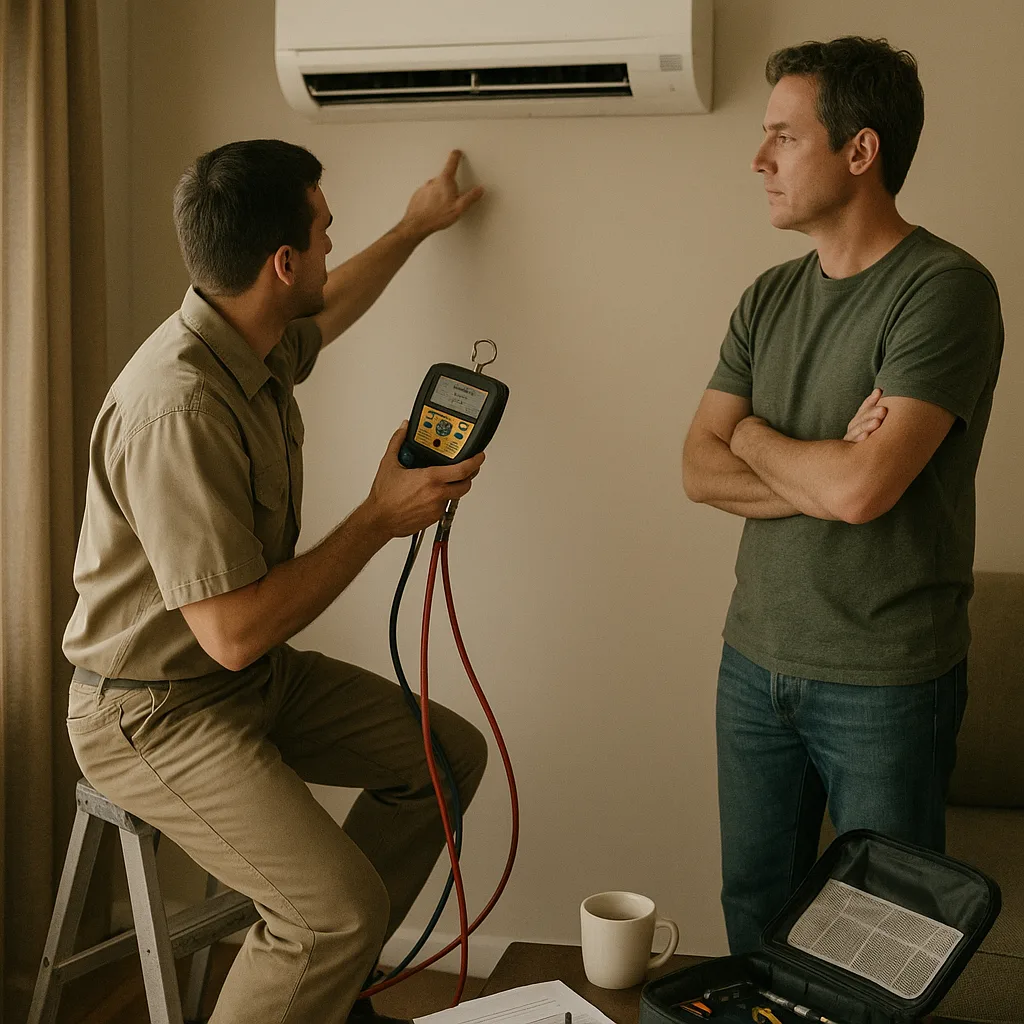
Your air conditioner runs but doesn't cool for one of a handful of common reasons: a clogged air filter, a thermostat set to Fan instead of Cool, low refrigerant from a leak, dirty condenser coils, a failing capacitor, or a frozen evaporator coil. Most of these you can check yourself in minutes. A few, like low refrigerant or a seized compressor, need a licensed technician.
Still blowing warm air after checking the basics below? Schedule a same-day AC repair before a small problem turns into a compressor replacement — and if a heat advisory is active in your area, don't wait it out.
Why Is My AC Running But Not Cooling?
An AC that runs but doesn't cool almost always traces back to one of a short list of causes, and most of them show up in the first ten minutes of a checklist. Start with the cheap, easy fixes before assuming you need a new system.
- Dirty or clogged air filter. A clogged filter can choke airflow and stop cool air from circulating through your home, so check it first[1]. Filters should be swapped every one to three months depending on use and air quality[1].
- Wrong thermostat setting. If the thermostat is set to Fan instead of Cool, the system blows air without ever changing the temperature[1].
- Low refrigerant. Refrigerant isn't consumed like fuel, so if levels are low, it almost always means there's a leak somewhere in the system[1].
- Dirty condenser coils. When the outdoor unit's coils are covered in dirt and debris, the system can overheat and struggle to cool your home[2].
- Failing capacitor. The capacitor helps start the compressor and fan motors, and when it's failing, the AC may run without producing any cool air at all. A clicking sound or a system that won't turn on are both signs of the same problem[1][2].
- Frozen evaporator coil. Frost on the copper tubing, weak cooling, or unusually heavy condensate drainage all point to a frozen coil[3].
- Wrong-sized unit. If the system was installed without correct load calculations, it may simply be too small to cool your house properly, no matter how well it runs[6].
Why Is My AC Blowing Warm Air Even Though the Fan Is Running?
A fan that runs while the air stays warm usually points to the compressor side of the system, not the fan itself. That means low refrigerant, a failing capacitor, or a frozen evaporator coil are the most likely culprits, because each of them stops the refrigeration cycle without stopping the fan.
Low refrigerant is the one to take most seriously. A leak can cause long run times and, left alone, lead to compressor failure over time[3]. A failing capacitor produces the same symptom for a different reason: it can keep the fan and compressor motors from starting properly, so the fan spins but nothing actually cools[1][2]. If the coil itself has frozen over, the airflow across it stays warm until the ice melts, no matter how long the fan runs[3].
Should I Turn Off the AC If It's Not Cooling?
Yes, turn off the AC if you notice a frozen coil, a burning smell, or signs the compressor is straining, because continuing to run it risks permanent damage. Running the system while it shows these signs can cause slugging in the compressor and damage it beyond repair, so it's worth losing a day of cooling to avoid a much bigger bill[4].
If the coil has frozen, turn the cooling system off for a full 24 hours so the ice can melt and the coil can return to normal before you try again[6]. If nothing looks visibly wrong, a quick filter check and thermostat check are safe first steps before you decide whether to shut the system down completely. During a heat advisory, losing cooling for even a few hours raises real risk for kids, older adults, and anyone with a health condition, so treat a no-cool AC as urgent rather than optional during those stretches.
What Is the 3-Minute Rule for Air Conditioners?
The 3-minute rule means waiting at least three minutes before restarting your AC after it shuts off, whether that shutoff was automatic or you turned it off yourself[7]. That pause gives the refrigerant pressure inside the compressor time to equalize.
Skipping that wait isn't a one-time risk, either. Restarting the compressor before pressure equalizes creates cumulative strain, and enough of that strain can make the compressor motor seize and refuse to turn even with power restored. At that point, the compressor itself usually needs full replacement, which is the single most expensive repair on a home AC system[7]. A cheap timer or just watching the clock protects a part that costs thousands to replace.
How Do I Reset My AC If It's Not Cooling?
Resetting an AC that isn't cooling starts with cutting power at the thermostat or breaker, waiting a few minutes, and checking the basics before you turn it back on. This simple sequence resolves a surprising share of these calls without a technician visit.
- Switch the thermostat off, or flip the breaker, and wait at least three minutes before restarting so compressor pressure can equalize[7].
- If you saw frost on the indoor coil or refrigerant lines, leave the system off for a full 24 hours instead so the ice can fully defrost[6].
- While it's off, pull the air filter and check it against a light. Replace it if you can't see light through it, since a clogged filter is one of the most common causes of this exact symptom[1].
- Confirm the thermostat is set to Cool, not Fan, and set to AUTO rather than ON, so the system only blows air once it's actually cooled[1][5].
- Restart the system and give it a few minutes to cycle before judging whether the air coming out has actually gotten colder.
If the same symptom returns right after a reset, that points to a mechanical issue, like a refrigerant leak or a failing capacitor, that a reset alone can't fix.
What Does It Mean If My Thermostat Is Set to ON vs AUTO?
A thermostat fan setting of ON runs the blower fan constantly, 24 hours a day, even when the air isn't being cooled[4]. AUTO, by contrast, only runs the fan when the system is actively cooling, so the air coming through the vents is always cold air.
That distinction matters more than most homeowners realize, because a system stuck on ON can feel broken even when nothing actually is. Switching the setting to AUTO should be enough to confirm your unit is only blowing air once it's cooled, which makes it one of the fastest, free diagnostic checks you can run[5][1].
Could a Wrong-Sized AC Unit Be Why My Home Won't Cool?
Yes, an undersized AC unit can run constantly without ever fully cooling your home, especially on the hottest days of the year. If the unit was installed without the correct measurements needed to properly cool the house, it may be too small to keep up no matter how well-maintained it is[6].
This cause is easy to miss because the system otherwise seems to work fine: it turns on, the fan runs, and cold air comes out. It just never catches up to the thermostat setting, particularly in the afternoon heat. If a professional visit rules out every mechanical cause above and the system still can't keep the house at temperature, sizing is worth investigating next.
How Much Does It Cost to Repair or Replace an AC That's Not Cooling?
Most AC repairs, like a capacitor swap or a coil cleaning, cost far less than replacing the whole system, which is why it's worth diagnosing the problem before assuming you need a new unit. National cost-engine estimates below come from BLS OEWS median HVAC technician wages plus typical parts costs. Treat them as a planning range, not a quote for your specific home. For a fuller breakdown by repair type, see our AC repair cost guide for 2026.
| Service | Low estimate | High estimate |
|---|---|---|
| AC tune-up / seasonal maintenance | $80 | $210 |
| Smart thermostat installation | $160 | $480 |
| Central AC replacement (3-ton system) | $3,520 | $7,030 |
These figures come from the CM cost engine, built on the BLS OEWS May 2025 median HVAC technician wage of $29.33 an hour. That wage is applied across typical task hours plus materials for each job. A tune-up or single-part repair, like a capacitor, sits at the low end of that range and often resolves the complaint outright. Full replacement only makes financial sense once a technician confirms the compressor or coil has failed, since those are the parts that push a repair bill toward replacement cost.
When Should You Call a Professional?
Call a professional as soon as you've ruled out the filter and thermostat and you're still seeing frost, warm air, or a fan that won't start. A low refrigerant charge almost always means a leak that needs a technician to find and repair[1], and a failing capacitor that causes clicking or a no-start condition needs a trained tech to replace safely[2]. If you're still weighing repair against replacement, our repair-vs-replace cost breakdown walks through both sides in more detail.
Checked the filter and thermostat and still stuck with warm air? Book a licensed AC repair technician today before a fixable issue turns into a full replacement.
FAQ
Why is my AC running but not cooling? The most common causes are a clogged air filter, a thermostat set to Fan or ON, low refrigerant from a leak, dirty condenser coils, a failing capacitor, or a frozen evaporator coil[1][1][1][2].
Should I turn off the AC if it's not cooling? Yes, if you see a frozen coil or signs of compressor strain, because continuing to run it can cause slugging that damages the compressor beyond repair[4]. Give a frozen coil a full 24 hours to defrost before restarting[6].
What is the 3-minute rule for air conditioners? It means waiting at least three minutes after shutoff before restarting your AC, so refrigerant pressure inside the compressor can equalize before the motor tries to start again[7][7].
How do I reset my AC if it's not cooling? Cut power at the thermostat or breaker, wait at least three minutes (or 24 hours if the coil was frozen), check the filter and thermostat settings, then restart and give the system a few minutes to cycle[7][6][1][1].
Could a wrong-sized AC unit be why my home won't cool? Yes, an undersized unit installed without correct load calculations can run constantly without ever fully cooling the house, especially in peak heat[6].
How much does it cost to repair or replace an AC that's not cooling? A tune-up or single-part repair typically runs $80 to $210, while replacing a 3-ton system nationally runs $3,520 to $7,030, based on CM cost-engine estimates using BLS wage data.
Sources
- AC Running But Not Cooling? Try These Quick Fixes - Pruett Air Conditioning
- Top 5 Reasons Your AC Isn't Cooling Properly - Berkeys
- Why Is My AC Not Blowing Cold Air? 7 Common Causes - Carrier
- Why Is My Central Air Conditioner Not Cooling? - Coolray
- Your AC Isn't Blowing Cold Air - Lennox
- What To Do When The AC Isn't Cooling Your House - Santa Energy
- What Is the 3-Minute Rule for Air Conditioners? - Berkeys Southlake